

EMDR can help with anger when the anger traces back to unprocessed trauma. It works on the memories, body reactions and beliefs that fire the outburst, rather than on the outburst alone. If your temper flares in ways that feel bigger than the moment, or you snap and then feel shame, a trauma-focused therapist can map where that reaction began and process it directly. At Alvarado Therapy we offer individual EMDR therapy and EMDR intensives for adults in California and New York, in English and Spanish.
Alvaradotherapy
Address the Roots of Anger
Alvarado Therapy offers individual EMDR therapy for adults in California, with care available in English and Spanish.
TL;DR
EMDR (eye movement desensitization and reprocessing) treats anger by processing the memories and triggers behind it, not by teaching you to suppress it.
Anger is often a leftover trauma symptom, so naming it at the start helps your therapist build the plan around it.
Sessions do not require you to retell your story in detail, and you can stop reprocessing at any point.
Strong feelings, including anger, can surface during processing and in the days after. That is a normal part of the work, and a skilled clinician plans for it.
Couples therapy can sit alongside EMDR when anger shows up mostly in your relationship.
Table of Contents
Why anger is often a trauma symptom
How EMDR works on the roots of anger
Choosing what to target when anger is the problem
What a session feels like, and what comes after
How long it takes
When anger lingers after other symptoms improve
Is EMDR right for your anger?
Care built around you
Our perspective
FAQ
Sources
Why anger is often a trauma symptom
Anger is a protective emotion. It directs your attention outward, toward a threat, and it prepares your body to act. When you have lived through abuse, neglect, violence, or years of feeling unsafe, your nervous system can learn to reach for that response fast. Later, a tone of voice, a criticism, or a feeling of being ignored can set it off, long before your thinking brain weighs in.
This is why Francine Shapiro, who developed EMDR, wrote in a review of EMDR in medicine that people who present with anxiety, depression, hypervigilance or frequent anger should be evaluated for adverse life experiences that may be driving the problem. The anger is the visible part. The cause may be a memory.
The pattern is common enough that researchers track it. A VA National Center for PTSD research summary reports that irritability and anger were the symptoms most likely to remain, even among people who had recovered from PTSD, with 60.7% still endorsing it after treatment. For you, that means two practical things: anger is worth raising explicitly, and it is not a personal failing. It is a recognized part of how trauma shows up.
How EMDR works on the roots of anger
The VA National Center for PTSD explains that EMDR rests on the idea that symptoms come from trauma memories that were never fully processed. The memory stays stuck in a raw form, so when something reminds you of it, your body reacts as if it is happening now.
In a processing session, the sequence the VA describes looks like this:
You and your therapist choose a target memory, often with an image that stands for the worst part.
You name a negative belief that goes with it, such as "I am not safe" or "I have to fight to be heard."
You rate how disturbing it feels and name the positive belief you would rather hold.
You focus on the memory while following bilateral stimulation, such as eye movements or tapping, in short sets of 20 to 40 movements.
Between sets, you notice what comes up: new thoughts, connections, body sensations.
This continues until the distress drops and the positive belief feels true, followed by a body scan for any leftover tension.
The same process is then repeated for current triggers and for imagined future situations.
Steps 1 and 7 matter most for anger. The childhood memory of being yelled at is one target. The present-day trigger, such as a partner's raised voice or a boss's email, is another. The future rehearsal is where you practice meeting that trigger without the old surge.
The American Psychological Association's PTSD guideline describes EMDR as a structured therapy associated with reduced vividness and emotion of trauma memories. It notes that EMDR does not involve extended exposure, detailed descriptions of the trauma, belief challenging or homework. That last point is a relief for many people with anger. You are not asked to argue with your own reactions or to practice a script between sessions.
What the eight phases mean for you
EMDR is not only the eye-movement part. A clinical overview of EMDR's structure lays out eight phases. The first is history taking, where your therapist learns what happened and which memories are tied to your current patterns. The second is preparation, where the model is explained, your concerns are addressed and your readiness for processing is judged. Reprocessing comes after that, and every session ends with a closing step.
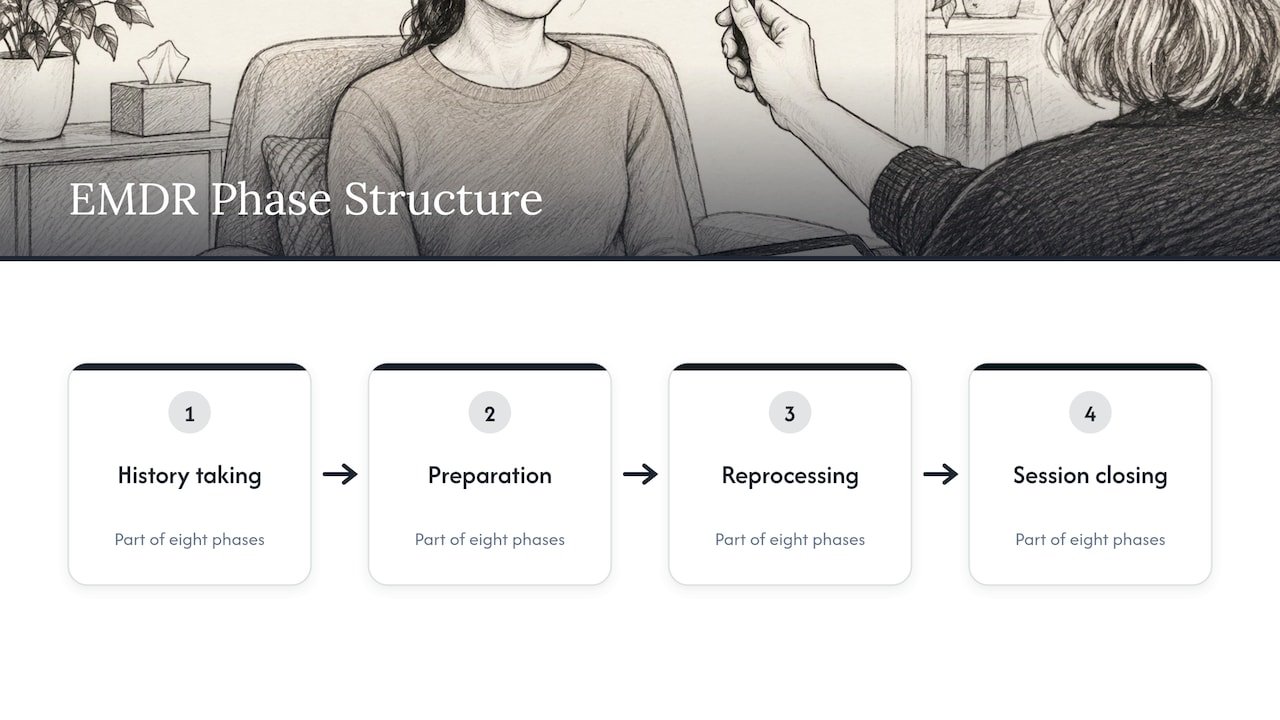
For anger, the early phases do real work. You and your therapist identify what the anger protects you from. Often the answer is shame, fear or helplessness. If you want a fuller walkthrough, our guides to the EMDR session process and preparing for EMDR therapy cover each stage.
Choosing what to target when anger is the problem
Anger rarely has a single source. Here are the kinds of targets a trauma-
Choosing what to target when anger is the problem
Anger rarely has a single source. Here are the kinds of targets a trauma-focused therapist may look at with you:
| Where the anger shows up | Possible target |
|---|---|
| Explosive reactions to feeling disrespected | Early memories of being humiliated, dismissed or powerless |
| Rage at a partner during conflict | Memories of betrayal, abandonment or being unsafe at home |
| Irritability and a short fuse after a frightening event | The event itself and the moment you felt most threatened |
| Anger followed by crushing guilt or shame | The belief "I am bad" and the memory where it first formed |
| Anger that appears with grief | The loss, plus any unspoken things or unresolved circumstances around it |
This is why the same label, "anger issues," can lead to very different treatment plans. If you grew up in a home where you had to be on guard, your plan will differ from someone whose anger began after a crime or an accident. Our page on PTSD and complex trauma explains how longer-term trauma changes the way we approach this, and our guide to EMDR for childhood abuse covers what adults can expect when the roots go back to childhood.
What a session feels like, and what comes after
The EMDR International Association's adult brochure states three things worth knowing before you start. You do not have to talk in detail about the distressing issue. You have full control to stop the reprocessing at any point. And sessions end with the therapist helping you feel grounded. It also notes that EMDR can be delivered in person or on a virtual platform by a properly trained and licensed clinician, which is how we offer it to Californians across the state.
During the session
You may feel heat in your chest, tension in your jaw, a clenched fist, or a flash of irritation as the memory moves. This is the body processing the memory, not a sign you are doing it wrong. The therapist keeps the sets short and checks in between them. Many people find that anger rises, peaks, and then turns into something underneath it, such as sadness or fear, and then eases.
In the days after
Processing can continue after you leave. Some people notice vivid dreams, tiredness, or an emotional day or two. Anger can feel closer to the surface for a short time, or noticeably quieter. Because EMDR does not use homework, your task is to rest, keep your routines, and note what you observe so you can bring it to the next session. Tell your therapist about any strong reaction, so the next session can be paced accordingly. Our step-by-step EMDR guide for trauma recovery describes the usual rhythm from one session to the next.
If you ever feel you might hurt yourself or someone else, call or text 988, the Suicide and Crisis Lifeline, or call 911, and tell your therapist as soon as you can.
How long it takes
The VA says EMDR is typically delivered in weekly individual sessions of up to 90 minutes over about three months. The APA guideline describes a typical course of 6 to 12 sessions at one to two a week, with a specific memory generally processed within one to three sessions. Your timeline depends on how many memories feed your anger and how long you have lived with them. A single frightening event usually needs fewer sessions than years of childhood stress.
If weekly sessions are hard to fit, or you want focused time on a pattern that has run for years, an intensive is another route. We publish these fees on our EMDR intensives page:
| Format | Fee |
|---|---|
| 1-Day Intensive, 4 hours in one day | $1,500 |
| 1-Day Intensive, 6 hours in one day | $2,250 |
| 3-Day Intensive | $5,750 |
Our guide to EMDR intensive therapy explains how the longer blocks are structured. Individual weekly sessions have no published fee, so reach out through our consultation page to ask about them.
When anger lingers after other symptoms improve
It is common to feel better in some areas while anger lags behind. Nightmares ease, you sleep, the panic fades, but your patience with the people closest to you is still thin. The VA figures above show this is a recognized pattern, and the U.S. Department of Defense's Psychological Health Center of Excellence notes that anger can reduce how well PTSD treatment works and that treatment aimed at anger itself has helped veterans reduce it and improve their social functioning.
That is a reason to put anger on the table early rather than hope it resolves on its own. A review of trauma-focused therapies found that treating PTSD brings a small-to-medium improvement in anger, with a pooled effect of Hedges' g = 0.33 across eight studies. Anger gets better alongside the rest of the work, and it improves most when it is a named part of the plan.
Two supports help while the work is underway:
Anger-specific skills. A randomized trial of 92 post-9/11 veterans found a cognitive behavioral anger program produced greater improvement in anger, relationships and quality of life than supportive therapy. Skills for noticing the early body signs of anger, pausing, and choosing a response can sit comfortably next to EMDR.
Steadier regulation day to day. Sleep, movement and routines that lower your baseline arousal matter, and some people also find that emotional support animals for BPD and regulation struggles offer a calming daily presence when emotions run intense.
When the anger lives in your relationship
A 2024 trial of brief couples-based PTSD treatments found significant reductions in veterans' angry temperament and angry reactions, and large reductions in psychological aggression in both treatment groups when partners took part together. The authors suggest that approaches targeting conflict management and interpersonal functioning may suit anger and aggression well. If your outbursts mostly land on a partner, couples therapy can work on communication and repair while you process the history individually. Partners who are healing from betrayal or infidelity often see anger in both people, and both are valid places to start.
Is EMDR right for your anger?
EMDR tends to be a good fit when you can link your anger to specific experiences, or when it comes with other trauma signs: flashbacks, jumpiness, avoidance, numbness, or shame. It also suits people who prefer not to narrate every painful detail, since the approach does not ask for it.
Some questions help you decide:
Does the anger feel out of proportion to what triggered it?
Do you recognize the feeling from earlier in your life, perhaps from childhood?
Do you feel guilt or shame afterward?
Do you have other trauma symptoms, such as startle responses, disrupted sleep or intrusive memories?
Is the anger hurting your relationships, your job, or your health?
If you answered yes to several, a consultation is a sensible next step. Bring a rough list of situations that set you off. You do not need to have identified the memories yourself. Finding them is part of the first phase.
If you are comparing options, our article on EMDR versus talk therapy lays out how the two differ for trauma, and our overview of EMDR treatment effectiveness summarizes the research. The VA reports that 38 randomized controlled trials of EMDR are included in its PTSD Repository, and that recent meta-analyses suggest moderate to strong effects on PTSD symptoms and depression.
If you have a serious medical condition, take medications that affect mood, or have a history of dissociation or substance use, tell your therapist at intake so the preparation phase can be tailored to you. Your physician or psychiatrist is the right person for questions about medications.
Care built around you
We are a trauma-informed practice with licensed therapists, and we offer care in English and Spanish, with a focus on identity-affirming, culturally responsive work for Latinx, BIPOC and LGBTQ+ clients. If your anger has roots in a history of discrimination, immigration stress, family expectations or violence, you should not have to explain your context before the work can start.
Our individual EMDR therapy is available in Pasadena, Ventura and online across California, and online in New York. If you want concentrated time, our EMDR intensives are offered in 4-hour, 6-hour and 3-day formats. You can book online or start with a consultation.

If you were harmed by a crime and your anger started afterward, our victims of crime service supports survivors through VOCA.
Our perspective
We rarely meet someone who wants to be angry. We meet people who are tired of apologizing, tired of the surge, and often frightened by how fast it takes over. Behind that surge there is almost always a story: a house where you had to stay alert, a moment when no one protected you, a loss that was never allowed room.
That is why we do not treat anger as a behavior to be managed and nothing more. We treat it as information. When we do EMDR with anger, we start by asking what the anger is guarding. Many clients are surprised to find that the answer is grief, fear or a belief about themselves that they picked up long ago. Once that memory is processed, the reaction often has less to hold onto.
We build care to fit the person. Some clients do best with weekly sessions. Others want the focus of an intensive. Some bring a partner into couples therapy for the relationship side. And because language and culture shape how anger is expressed and judged, we offer therapy in English and Spanish, with an identity-affirming approach. You should be able to bring your whole self into the room.
Juiced
FAQ
Can EMDR make you angrier?
Anger can surface during processing or in the days after, because you are touching memories that carried it. It often shifts into sadness or relief as the memory is processed. Your therapist paces the sessions, and you can stop reprocessing whenever you need. Tell your clinician about strong reactions between sessions so they can adjust the next one.
How many EMDR sessions does anger take?
It depends on how many memories feed the reaction. The APA guideline describes a typical course of 6 to 12 sessions, and the VA describes weekly sessions over about three months. Longer histories, such as childhood trauma, can take more time. An intensive can condense the work into concentrated blocks.
What should I expect after the first EMDR session?
The first sessions are usually history taking and preparation, so you may feel more reflective than stirred up. Once reprocessing begins, you may be tired or emotional for a day or two, and sometimes dream vividly. Rest, keep your routine, and note what you notice to share at your next session.
Do I have to talk about everything that happened?
No. The EMDR International Association states that EMDR does not require detailed talking about the distressing issue. You share what you need to for your therapist to guide the work, and you keep control of the pace.
Sources
The Impact of Trauma-Focused Psychotherapies on Anger (Wells et al., 2024)
The Role of Eye Movement Desensitization and Reprocessing in Medicine (Shapiro, 2014)
Eye Movement Desensitization and Reprocessing for PTSD, VA National Center for PTSD
The Structure of EMDR Therapy: A Guide for the Therapist, Frontiers in Psychology
Problematic Anger and Posttraumatic Stress Disorder, Psychological Health Center of Excellence
Treatment of anger problems in previously deployed post-9/11 veterans (Shea et al., 2021)
Examining the Impact of Brief Couples-Based PTSD Treatments (Wells et al., 2024)
