
EMDR in Spanish: 8 Phases, Care Without Translation

EMDR, known in Spanish as Desensibilización y Reprocesamiento por Movimientos Oculares (DRMO), is an evidence-based trauma treatment, and it can be delivered effectively in Spanish. Major guidelines recognize it as an effective therapy for PTSD and related trauma symptoms. If Spanish is your preferred language for therapy, look for a bilingual clinician or an EMDR-trained provider who can conduct the full protocol in Spanish rather than through translation.
TL;DR:
Sessions usually last 50 to 90 minutes, and treatment can span weeks or months depending on the number and complexity of memories being processed.
Before memory work begins, therapists teach grounding and stabilization; vivid dreams, resurfacing memories, or mild emotional fatigue can occur between sessions, so report severe reactions promptly.
Research finds EMDR reduces PTSD symptoms more than passive controls, while outcomes broadly resemble other active PTSD therapies and vary across study designs and populations.
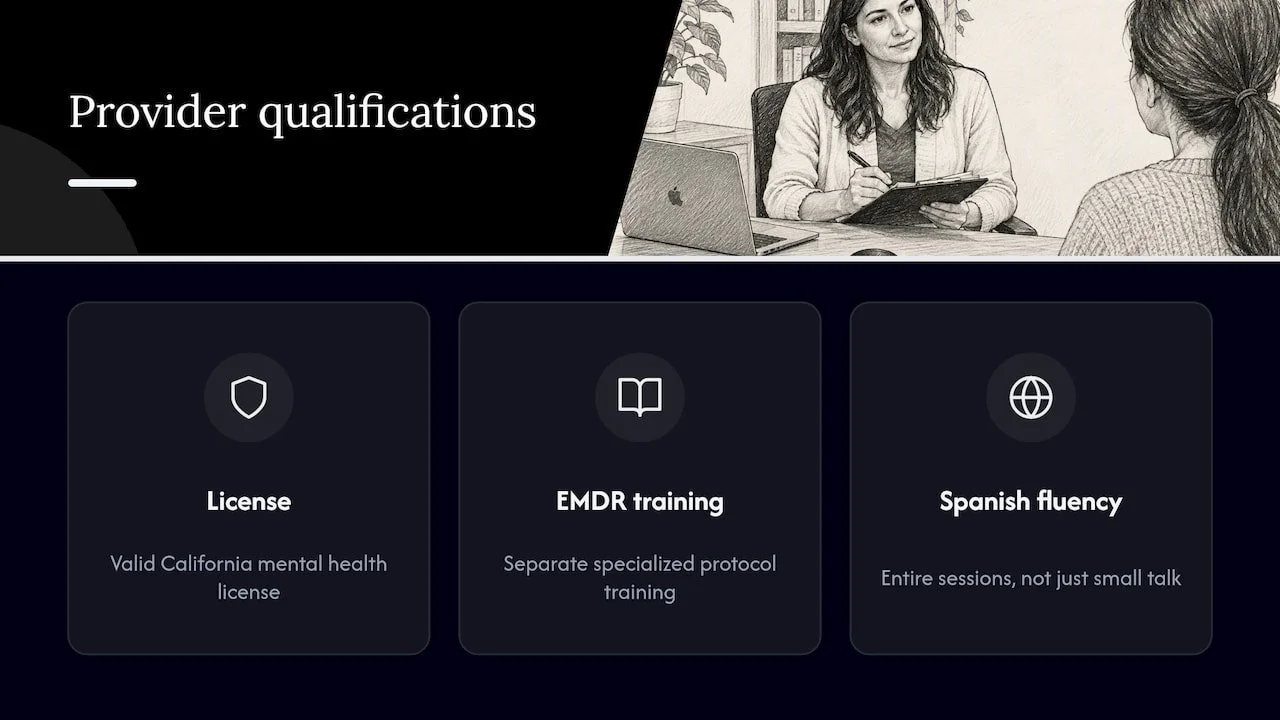
When choosing a provider, verify an active mental health license, specialized EMDR training, and fluency to conduct the entire protocol in Spanish.
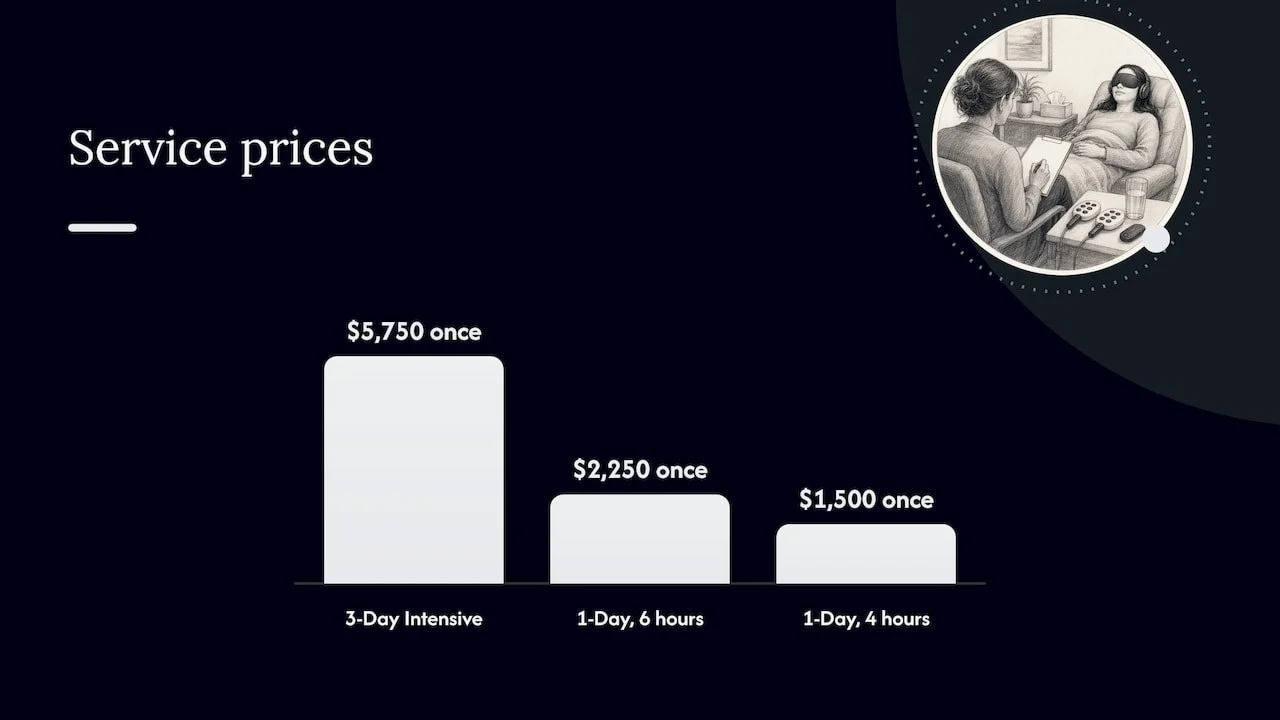
For concentrated care, Alvarado Therapy lists intensives from $1,500 for four hours to $5,750 across three consecutive days; weekly therapy pricing is available on request.
Alvaradotherapy
Explore EMDR Care in Spanish
Alvarado Therapy offers bilingual, trauma-informed care in English and Spanish, including EMDR therapy for clients across California.
Table of Contents
What is EMDR, or DRMO, and how does it work?
DRMO stands for Desensibilización y Reprocesamiento por Movimientos Oculares, the formal Spanish name for Eye Movement Desensitization and Reprocessing. You may also see it abbreviated simply as EMDR in Spanish-language clinical materials, since the English acronym is widely used alongside the translated name.
The therapy rests on a concept called the Adaptive Information Processing model, which holds that distressing memories can get "stuck" without being fully processed by the brain, continuing to trigger emotional and physical reactions long after the event. During treatment, your therapist guides you through brief sets of bilateral stimulation, meaning rhythmic eye movements, taps, or tones that alternate between the left and right sides of your body, while you briefly focus on a distressing memory.
The dual-attention process keeps you aware of the present moment while the memory is activated.
Bilateral stimulation can take the form of guided eye movements, alternating hand taps, or auditory tones through headphones.
The goal is to help the nervous system reprocess the memory so it no longer carries the same emotional charge.
The eight phases of the EMDR protocol
EMDR follows a structured, eight-phase protocol that your therapist uses to guide treatment from start to finish.
History taking: your therapist gathers background on your trauma history and current symptoms.
Preparation: you learn grounding and coping skills before any memory processing begins.
Assessment: you and your therapist identify the target memory, along with its image, belief, and emotion.
Desensitization: sets of bilateral stimulation reduce the distress tied to the memory.
Installation: a positive belief about yourself is strengthened in place of the old one.
Body scan: you check for any remaining physical tension linked to the memory.
Closure: each session ends with a return to a calm, stable state.
Re-evaluation: later sessions review progress and check whether the memory still triggers distress.
Within a single session, your therapist typically runs several sets of bilateral stimulation, pausing after each to ask what came up, then adjusting the next set based on your response. Sessions generally last 50 to 90 minutes, and how many sessions you need depends on the complexity of what you're processing.
What happens during and between EMDR sessions?
A typical EMDR session runs 50 to 90 minutes, and a full course of treatment can range from several weeks to several months depending on how many memories need processing and how complex your trauma history is. Before any memory work begins, your therapist spends time on stabilization so you feel equipped to handle the process.
Expect a safe-place exercise early on, where you build a mental image or sensation you can return to if things feel overwhelming.
Grounding techniques and resourcing exercises help you stay oriented during sessions.
Some clinicians use tools like CIPOS (containment and present-orientation techniques) or the butterfly hug, a self-administered form of bilateral stimulation, to support emotional regulation.
It's common to notice vivid dreams, new memories surfacing, or mild emotional fatigue between sessions, and these reactions are a normal part of reprocessing.
Pro Tip: Keep a brief log of anything that comes up between sessions, including dreams, new memories, or shifts in mood, so you can share it with your therapist at your next appointment.
If you experience a reaction that feels severe or disorienting, telling your therapist promptly lets them adjust the pace of treatment to keep you safe.
How effective is EMDR, according to the research?
EMDR shows larger effects than passive controls and effects broadly comparable to other active trauma-focused therapies across the body of research on PTSD treatment, though results vary across studies.
A recent systematic review and meta-analysis found that EMDR reduces PTSD symptom severity more than passive control conditions, and that its effects look similar to other established trauma-focused treatments, with some variation across individual trials. This pattern holds up across multiple reviews, though researchers note meaningful heterogeneity depending on study design, population, and how outcomes were measured.
Guideline bodies have weighed in clearly on where EMDR fits:
The American Psychological Association includes EMDR among the psychotherapies addressed in its clinical practice guideline for PTSD, alongside trauma-focused cognitive behavioral approaches.
The VA and the National Center for PTSD list DRMO as a recommended, trauma-focused therapy in their Spanish-language patient resources.
Clinicians commonly track two in-session measures, the Subjective Units of Disturbance and the Validity of Cognition scale, to decide when a memory has been sufficiently processed.
One ongoing debate in the field concerns whether the eye movements themselves are a necessary ingredient or whether the benefit comes mainly from the structured exposure and reprocessing steps. Dismantling studies that remove the eye movement component have produced mixed findings, which is part of why some reviews describe EMDR's effects as comparable to, rather than clearly superior to, other active trauma-focused treatments. For a deeper look at this research, our summary of EMDR treatment effectiveness walks through the evidence in more detail.
Why language and culture matter in EMDR treatment
Traumatic memories are often encoded in the language you were living in when the event happened, which is part of why delivering EMDR in a client's native language can make reprocessing more direct and efficient. Working through trauma in Spanish, rather than through translation or a second language, can also strengthen the rapport and trust that make the therapeutic relationship work.
A few practical steps can help you get care that fits your language needs:
Ask directly during intake whether your therapist conducts full sessions in Spanish, not just initial conversations.
Request Spanish-language worksheets, scripts, and psychoeducation materials so preparation and homework match your session language.
Consider a bilingual EMDR intensive if you want concentrated, consecutive-day sessions conducted fully in Spanish.
Look into bilingual training resources, such as EMDRIA's bilingual refresher courses, which reflect the field's growing attention to Spanish-language delivery.
The VA's Spanish-language family guidance also offers a helpful window into what Spanish-speaking clients and their loved ones can expect from DRMO treatment.
Practitioner qualifications and licensing for EMDR in Spanish
Providing EMDR therapy in California requires a valid mental health license, such as a Licensed Marriage and Family Therapist, Licensed Clinical Social Worker, Licensed Professional Clinical Counselor, or licensed psychologist, issued by the relevant California board. Licensure alone does not qualify someone to practice EMDR: clinicians need separate, specialized training in the EMDR protocol, typically through an EMDR International Association-approved training program, before they can ethically offer it to clients.
Delivering EMDR in Spanish adds another layer of qualification. A clinician needs genuine fluency in Spanish, not just conversational ability, because the precise wording used during assessment and reprocessing phases matters for accuracy. Many bilingual practitioners also pursue additional coursework focused specifically on conducting EMDR scripts and protocols in Spanish, since direct translation of English materials can miss cultural or linguistic nuance.
When you're vetting a provider, it's reasonable to ask about their license type and number, their EMDR training level, and whether they conduct the entire session, not just small talk, in Spanish. A therapist who meets all three markers is positioned to deliver the protocol as intended rather than through an improvised translation.
Our perspective on bilingual EMDR care
We built our practice around the idea that trauma-focused therapy should be available in the language a client actually thinks and feels in, not just the language a form is printed in. As a California-based, trauma-informed practice, we offer bilingual EMDR and EMDR intensives, along with online sessions for clients who need flexibility around location or scheduling, so Spanish speakers can access the full protocol without compromise.
— Juiced
Bilingual EMDR therapy options with Alvarado Therapy
If you're ready to start EMDR in Spanish, we offer several paths depending on your pace and goals. Individual EMDR sessions build gradually over weeks or months, while our EMDR intensives compress the work into focused, consecutive days for clients who want faster symptom relief.

| Format | Duration | Price |
|---|---|---|
| 3-Day EMDR Intensive | 3 consecutive days | $5,750 one-time |
| 1-Day EMDR Intensive (6 hours) | 6 hours, one day | $2,250 one-time |
| 1-Day EMDR Intensive (4 hours) | 4 hours, one day | $1,500 one-time |
| Individual Counseling / EMDR Therapy | Weekly sessions | Available on request |
All of our services are trauma-sensitive and identity-affirming, and sessions are available online throughout California. For a closer look at how an intensive format works for Spanish-speaking clients, our post on bilingual EMDR intensives for immigrants walks through what to expect. When you're ready to move forward, you can book a consultation to talk through which format fits your situation.
This article is general information, not a substitute for advice from a qualified doctor. Consult a qualified healthcare professional about your own circumstances before acting on anything here.
FAQ
What are the side effects of EMDR?
Some people notice vivid dreams, temporary emotional fatigue, or new memories surfacing between sessions as part of normal reprocessing. These reactions are typically short-lived, and a trained therapist will teach you grounding techniques beforehand to manage them.
What is EMDR therapy called in Spanish?
EMDR is called Desensibilización y Reprocesamiento por Movimientos Oculares, abbreviated DRMO. The English acronym, EMDR, is also commonly used in Spanish-language clinical settings.
What is another name for EMDR therapy?
Within English-language materials, EMDR is sometimes referred to by its full name, Eye Movement Desensitization and Reprocessing, rather than the acronym. In Spanish, the equivalent full name is Desensibilización y Reprocesamiento por Movimientos Oculares, or DRMO.
Why is there a controversy with EMDR?
The debate centers on whether the eye movements themselves add unique value or whether the benefit comes mainly from the exposure and cognitive reprocessing built into the protocol. Dismantling studies that remove the eye movement component have produced mixed results, which keeps this question open among researchers even as EMDR's overall clinical effectiveness remains well supported.
How do I know if a therapist is qualified to do EMDR in Spanish?
Ask about their mental health license, their level of EMDR-specific training, and whether they conduct the full session in Spanish rather than translating on the fly. A qualified bilingual EMDR therapist should be comfortable answering all three questions directly.
Sources
Desensibilización y Reprocesamiento Por Movimientos Oculares (DRMO) Para el TEPT - PTSD
Eye Movement Desensitization and Reprocessing (EMDR) Therapy — APA
