
How to Rebuild a Marriage: Practical Steps That Work

Yes, you can rebuild a marriage — but it requires stopping the damage first, not just trying harder to connect. The couples who make it through don't do so by going back to who they were before the crisis. They build something new, and they usually do it in a specific order: stop the harm, take personal responsibility, rebuild safety, then reconnect. Methods like the Gottman Method, Emotionally Focused Therapy (EFT), and Cognitive Behavioral Therapy (CBT) all share that sequencing. When trauma is part of the picture, EMDR often runs alongside couples work to address what's underneath.
Here's what to do in the first 72 hours:
Stop the behavior causing the most damage. Contempt, threats, stonewalling, or ongoing deception — identify the single most destructive pattern and commit to stopping it today, not after the next argument.
Establish physical and emotional safety. If there is any physical danger, that takes absolute priority. For emotional safety, agree on a temporary boundary: no major decisions about the marriage for at least two weeks.
Take personal responsibility for your part. Not your partner's part — yours. Write it down privately if needed. Accountability starts before the first repair conversation.
Agree on a pause protocol. If a conversation escalates, both partners agree to stop and return to it at a set time.
Contact a therapist or crisis line if safety is in question. This is not optional.
Pro Tip: When you feel flooded during a conversation, your nervous system is genuinely unable to process information rationally. A minimum 20–30 minute intentional break is needed to reset — not a five-minute breather. Set a timer, separate physically, and do something calming (not rehearsing arguments). Return at the agreed time.
Key Takeaways
Rebuilding a marriage is possible when both partners commit to stopping the damage first, taking personal responsibility, and rebuilding trust through consistent action over time — not through a single conversation or gesture.
| Point | Details |
|---|---|
| Stop the damage first | Identify the most destructive behavior and halt it before attempting reconnection. |
| Own your part specifically | Write down your contributions privately; vague accountability doesn't hold under pressure. |
| Trust rebuilds through repetition | Weekly check-ins and small kept commitments outperform grand gestures every time. |
| Get professional help early | Evidence-based therapy (Gottman, EFT, EMDR) shows measurable progress within 2–3 months when both partners engage. |
| Alvarado therapy | Offers trauma-informed couples therapy and EMDR in California and New York, in English and Spanish. |
Table of Contents
What causes a marriage to break down?
Most marriages don't collapse in a single moment. The more common story is a slow erosion: small criticisms that calcify into contempt, emotional withdrawal that becomes a habit, and a gradual loss of the friendship that held everything together. Understanding which pattern matches your situation matters because the repair approach differs.
Slow-erosion patterns include:
Chronic criticism or contempt (dismissing your partner's character, not just their behavior)
Emotional disengagement and parallel lives
Mismatch of values or life goals that widened over time
Chronic stress from finances, parenting, or caregiving that was never processed together
Neglect of intimacy, both physical and emotional
Acute betrayals include:
Infidelity or sexual betrayal
Addiction and the deception that accompanies it
A single catastrophic breach of trust (financial deception, hidden illness, major lie)
The repair approach differs significantly between these two categories. Slow erosion usually responds well to structured communication work and intentional reconnection. Acute betrayals require a stabilization phase first, where safety and basic functioning come before any attempt at deep repair. Trying to reconnect emotionally before the crisis is stabilized often backfires. Marriage counselors consistently advise redefining the relationship rather than trying to restore the exact dynamic that existed before — that prior version is gone, and chasing it sets both partners up for disappointment.
Red flags that require immediate professional intervention or safety planning:
Any physical violence, threats, or coercive control
Active substance misuse that is causing harm to either partner or children
Suicidal ideation in either partner
Ongoing emotional abuse (isolation, humiliation, financial control)
A partner who refuses any accountability or denies documented events
If any of these apply, skip the communication exercises below and go directly to the safety and special cases section.
How to rebuild your marriage: a step-by-step plan
The order here is not arbitrary. Couples who skip to reconnection before stopping the damage tend to cycle back through the same crisis. Effective repair follows a sequence: stop the bleeding, own your part, rebuild the foundation, reconnect slowly, then protect what you've built.
Phase 1: Stop the damage (week 1)
Identify and halt the most destructive behavior. Name it specifically: "I will stop bringing up past failures during current arguments." Vague commitments don't hold.
Agree on a temporary truce. No ultimatums, no major decisions about separation or divorce for at least two weeks. This creates enough space to think clearly.
Separate the crisis from daily function. Keep routines intact where possible — meals, parenting logistics, sleep schedules. Stability in small things matters.
Phase 2: Own your part (week 1–2)
Write a private accountability inventory. List your specific contributions to the problem. Not your partner's — yours. This is not about blame; it's about clarity.
Make one genuine acknowledgment. Not a full repair conversation yet. Just: "I know I've contributed to this. I want to work on my part." Short, specific, no defensiveness.
Phase 3: Rebuild safety (weeks 2–4)
Establish predictability. Do what you say you will do, consistently. Small kept commitments rebuild trust faster than grand gestures.
Create a weekly check-in ritual. Fifteen minutes, forward-focused, structured (see the trust section below).
Limit high-stakes conversations to agreed times. Ambushing a partner with a serious topic when they're tired or distracted guarantees a bad outcome.
Phase 4: Reconnect slowly (month 1–3)
Reintroduce positive interactions deliberately. One shared activity per week that has no agenda. Not a "relationship talk" — just time together.
Practice repair attempts. Small gestures that say "I want to de-escalate" — a touch on the arm, "I'm sorry, let me start over," a brief humor break. These matter more than most couples realize.
Phase 5: Protect progress (month 3–12+)
Review and adjust. What's working? What's slipping? A monthly honest check-in prevents backslide.
Continue individual work. Personal therapy alongside couples work is often what sustains the gains.
Pro Tip: Structure your weekly check-in as three questions: What went well this week between us? What's one thing I can do better? What do I need from you this week? Keep it to 15 minutes. The time limit prevents it from becoming another conflict.
A note on individual therapy: if you're carrying unresolved grief, anxiety, childhood trauma, or your own history of betrayal, couples therapy alone may not be enough. Individual work running concurrently is not a sign of failure — it's often what makes the couples work stick.
For practical conflict-resolution frameworks you can use at home, Alvaradotherapy's guide on couples counseling for conflict resolution covers structured exercises worth reviewing alongside this plan.
How do you actually rebuild trust after it's broken?
Trust repair requires four things: transparency, genuine remorse, consistent behavior over time, and gradual reconnection. One sincere apology doesn't rebuild trust. Twelve weeks of consistent, reliable behavior starts to.
Concrete trust-building exercises
Weekly trust check-ins (15 minutes): Sit together once a week and answer two questions: "Is there anything I did this week that eroded your trust?" and "What's one thing I did that helped?" Small, consistent commitments and the act of naming them out loud reframe the relationship toward reliability.

Micro-commitments: Agree on one small, specific, verifiable commitment per week. "I will text you when I leave work" is better than "I will be more communicative." Follow through. Then do it again next week.
Transparency practices: For couples recovering from deception, transparency means proactively sharing information — not waiting to be asked. This feels uncomfortable at first. That discomfort is part of the process.
What meaningful accountability sounds like:
"I understand why you don't trust me right now. I broke that trust, and I'm going to show you through my actions that I'm working on it."
"I'm not going to ask you to trust me. I'm going to earn it."
What to avoid:
"I already apologized. Why are you still bringing this up?"
Apologies that include "but" — "I'm sorry, but you also..."
Demanding a timeline for when your partner should be "over it"
Trust recovery timeline
| Phase | Timeframe | What typically happens |
|---|---|---|
| Stabilization | Weeks 1–4 | Crisis slows; basic safety and daily function restored; first accountability statements made. |
| Early repair | Months 1–3 | Consistent small commitments; first signs of reduced hypervigilance; check-ins established. |
| Rebuilding | Months 3–6 | Positive interactions increase; repair attempts accepted more often; emotional safety grows. |
| Integration | Months 6–12+ | New relationship patterns solidify; trust is conditional but functional; intimacy begins returning. |
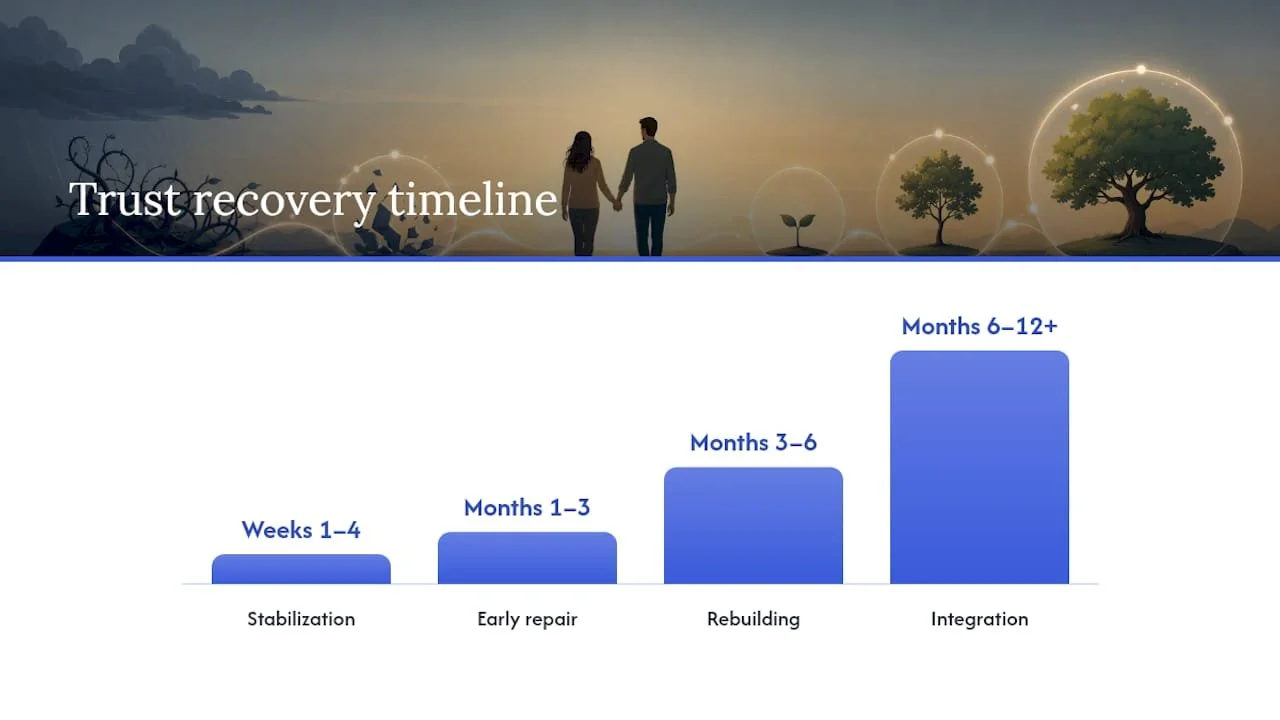
Setbacks happen in every one of these phases. A single bad week in month four doesn't erase three months of progress — but it does require a repair attempt, not silence.
Communication tools that actually change how you fight
The first three minutes of a conflict conversation predict its outcome more reliably than almost anything else. Starting with an attack — "You never listen," "You always do this" — triggers defensiveness immediately, and the conversation is effectively over before it begins. The Gottman-based concept of a "soft start-up" addresses this directly: lead with your feeling and your need, not a judgment of your partner's character.
The soft start-up formula
Instead of: "You never make time for me." Try: "I've been feeling disconnected lately, and I'd really like us to plan something together this week."
The structure is: observation + feeling + need + request. This is also the backbone of Nonviolent Communication (NVC), developed by Marshall Rosenberg — a framework that pairs well with Gottman-based couples work.
Active listening in practice
Most people listen to respond, not to understand. The turn-by-turn structure below slows that down:
Partner A speaks for 2–3 minutes without interruption.
Partner B paraphrases: "What I heard you say is..." (not a rebuttal — a reflection).
Partner B validates: "That makes sense that you'd feel that way, given..."
Partner B asks one clarifying question.
Switch.
This feels mechanical at first. Do it anyway. The mechanics create enough safety for real content to emerge.
Time-out rules
When emotional flooding hits — racing heart, tunnel vision, the urge to say something you'll regret — the conversation needs to stop. Rules that make time-outs work:
Both partners must agree to the time-out, not just one storming off.
Minimum 20–30 minutes. Shorter doesn't allow the nervous system to reset.
No ruminating on the argument during the break. Do something physical or calming.
Return at the agreed time, even if you don't feel ready. Showing up matters.
Daily rituals that restore warmth
Small positive interactions, done consistently, shift the emotional climate of a marriage faster than most couples expect. Gottman's research points to a 5:1 ratio — five positive interactions for every negative one as a marker of relationship stability. Practically, that looks like:
A six-second kiss hello or goodbye (long enough to actually register)
One specific appreciation per day: "I noticed you handled that call with your mom really well today"
A two-minute check-in at the end of the day: "How was your day, really?"
Pair these with family wellness activities that get both partners out of the house and into a shared experience — even a 20-minute walk counts.
Pro Tip: Practice communication scripts outside of conflict, not during it. Write out a soft start-up for a real issue you've been avoiding, then read it aloud to yourself. The first time you use a new communication structure in a live argument is not the time to learn it.
When the issue is infidelity, addiction, or abuse
These situations require a different first response. Attempting standard relationship repair before addressing the underlying crisis often makes things worse.
Immediate safety triage
Stop and assess before anything else. Seek immediate help if any of the following apply:
Physical violence, threats, or intimidation of any kind
Coercive control (monitoring movements, controlling finances, isolating from family)
Active suicidal ideation in either partner
Ongoing substance use that is creating danger for anyone in the household
A partner who is actively denying or minimizing documented abuse
If you are in danger: Call the National Domestic Violence Hotline at 1-800-799-7233 (TTY: 1-800-787-3224) or text START to 88788. For immediate danger, call 911.
Infidelity
The betrayed partner and the partner who betrayed are often in completely different emotional places at the same time — one in acute crisis, the other in shame and shutdown. Trying to have a full disclosure conversation in the first 48 hours usually retraumatizes both people. Therapy after infidelity typically begins with stabilization and basic safety before any detailed exploration of what happened and why.
Practical immediate steps:
Agree on a temporary boundary around contact with the third party (if applicable).
Limit disclosure details to what is necessary for safety and decision-making — not a full forensic account in week one.
Both partners seek individual therapy support immediately, not just the betrayed partner.
Pause major life decisions (moving, divorce filing, financial changes) for at least 30 days.
Addiction
Relationship repair cannot be the primary treatment for addiction. The medical and safety dimensions of substance use come first. If a partner is in active addiction:
Prioritize medical safety, including withdrawal management with a physician.
Involve an addiction specialist before couples therapy begins.
Understand that the relationship patterns that developed around the addiction (enabling, hypervigilance, chronic dishonesty) are their own layer of work, separate from the substance use itself.
Abuse
Couples therapy is contraindicated when one partner is abusing the other. Joint sessions in an abusive relationship can increase danger by giving the abusive partner information to use later. Individual safety planning with a trained advocate comes first.
Crisis and referral resources:
National Domestic Violence Hotline: 1-800-799-7233 | thehotline.org
SAMHSA National Helpline (addiction): 1-800-662-4357 | samhsa.gov/find-help/national-helpline
Crisis Text Line: Text HOME to 741741
988 Suicide and Crisis Lifeline: Call or text 988
Which therapy approaches actually help rebuild a marriage?
Couples in moderate-to-severe distress can show meaningful improvement with evidence-based therapy, with measurable progress often appearing within 2–3 months and larger gains over a 6–18 month engagement when both partners are actively involved. The key word is "both" — one partner doing all the work in sessions while the other disengages produces limited results.
The main evidence-based approaches
Gottman Method Couples Therapy targets the specific behaviors that predict relationship failure — contempt, criticism, defensiveness, and stonewalling (the Four Horsemen) — and replaces them with structured communication tools, repair rituals, and fondness-building practices. It's particularly effective for couples dealing with communication breakdown and chronic conflict.
Emotionally Focused Therapy (EFT), developed by Dr. Sue Johnson, works at the attachment level. It helps partners identify the underlying emotional needs driving their conflict cycles and restructure how they turn toward each other. EFT tends to be especially effective for couples where one or both partners feel chronically disconnected or abandoned.
Cognitive Behavioral Therapy (CBT) applied to couples focuses on identifying and changing the thought patterns and behaviors that maintain conflict. It's structured, skills-based, and works well for couples who respond to a more concrete, homework-driven approach.
EMDR (Eye Movement Desensitization and Reprocessing) enters the picture when one or both partners carry trauma that is driving the relationship dysfunction. A partner with unresolved childhood trauma, PTSD, or a traumatic event within the marriage may find that couples work stalls until that underlying material is addressed. Trauma-informed EMDR is often run individually alongside couples sessions, not as a replacement for them.
Combining attachment repair (EFT) with behavioral change tools (Gottman or CBT) tends to produce more durable outcomes than any single approach alone, particularly for complex cases involving betrayal or trauma.
What to look for in a therapist
Licensed as an LMFT, LCSW, or licensed psychologist with specific couples training
Trained in at least one evidence-based modality (Gottman Level 2+, EFT Externship, EMDR Basic Training)
Trauma-informed, especially if either partner has a trauma history
Bilingual or culturally responsive care if language or cultural context matters to your situation
Teletherapy availability if in-person access is limited
Questions to ask in intake: "What's your approach when one partner is more motivated than the other?" and "How do you handle it if individual trauma comes up in couples sessions?"
Cost and timeline expectations
Homework adherence matters. Couples who practice the skills between sessions consistently report better outcomes than those who treat therapy as the only place repair happens. A couples counseling overview can help you understand what to expect before your first session.
What actually works in the room: a clinician's perspective
The couples who make real progress share one quality that has nothing to do with how bad things got: they each stay focused on what they can change about themselves, not what they need their partner to change. That sounds simple. In practice, it's one of the hardest things to sustain when you're hurt and exhausted.
What I see work most often is not the grand gesture or the breakthrough conversation. It's the couple who shows up to the next session after a terrible week and says, "We had a bad one, but we didn't quit." Repair is rarely linear. A setback in month three doesn't mean the work isn't working — it means the work is real, and real things are hard.
One thing worth naming: one person changing their behavior genuinely can shift a relationship's trajectory. You don't need both partners to be equally motivated on day one. Sometimes one person's consistent accountability creates enough safety for the other to begin moving. That's not a guarantee, and it's not fair — but it's true often enough to matter.
The reframe I return to most often with couples is this: you're not trying to get back to the marriage you had. That version is gone. What you're building is something new, between who you both are now. That shift in expectation alone tends to reduce the pressure enough for real work to begin.
Alvarado Therapy offers couples and trauma-informed care in California and New York
Rebuilding a marriage is hard enough without trying to find the right therapist at the same time. Alvaradotherapy offers online couples therapy in California and New York, with licensed therapists trained in trauma-informed approaches, EMDR, and evidence-based couples work. Sessions are available in both English and Spanish.
For couples where trauma, PTSD, or a history of betrayal is part of the picture, the practice integrates EMDR with couples work so both layers get addressed — not just the relationship surface. New clients can expect a first consultation that focuses on understanding your specific situation before any treatment plan is set. Fees vary by clinician; contact the practice directly to ask about rates, insurance, and trauma-informed credentials.
Schedule a consultation to speak with a therapist and find out whether couples therapy, individual EMDR, or a combination is the right starting point for your situation.
Sources
The following sources informed this guide and are worth exploring for deeper reading. Links are provided for reference and are not vendor endorsements.
What Rebuilding Trust Looks Like in Couples Therapy | Psychology Today
How to Rebuild Trust in Marriage: Practical Steps When the Bond Is Broken
Couples communication breakdown (conflict, flooding) — SimplyPsychology
Additional Alvaradotherapy resources:
This article provides general educational information and is not a substitute for professional mental health advice. If you are in crisis or facing safety concerns, contact a licensed clinician or call 988 (Suicide and Crisis Lifeline) or 911 immediately.
