
Therapy’s $400 Good Faith Estimate Rule for Patients and Therapists

Yes: under the No Surprises Act, uninsured or self-pay therapy clients, along with any patient who asks, have the right to a Good Faith Estimate (GFE) showing expected charges before care begins. A GFE is an itemized, non-binding estimate, not a bill or a promise about session count, and if actual charges exceed it by $400 or more, patients can pursue the Patient-Provider Dispute Resolution (PPDR) process. Below, we cover what belongs in a therapy GFE, delivery deadlines, how to read one, and a practical workflow for clinicians.
TL;DR:
The estimate should itemize each service, applicable codes, per unit charges, expected frequency, duration, provider name, and assumptions, while separating included fees from exclusions.
One estimate may cover recurring care for up to 12 months if it states session frequency, per session fee, and timeframe; longer treatment requires an update.
Direct requests require delivery within 3 business days; scheduled care requires 1 day for 3 to 9 days’ notice, or 3 days for 10 or more.
When treatment changes, the provider should issue a revised estimate at least 1 business day before the added or changed service begins.
Patients may dispute bills at least $400 above one provider’s estimate within 120 calendar days; filing costs $25, refundable if the reviewer rules for them.
Alvaradotherapy
Explore Trauma-Informed Therapy
Alvarado Therapy offers individual counseling, EMDR therapy, and immigration evaluations for clients across California, in English and Spanish.
Table of Contents
How to read your therapy Good Faith Estimate before you agree to care
Building a compliance workflow therapists can actually follow
What happens if the bill is higher than the estimate: the PPDR process
Why transparent cost estimates matter in trauma-informed care
What a Good Faith Estimate actually is
A Good Faith Estimate is a written, itemized breakdown of the services a therapy practice reasonably expects to provide and what each one is likely to cost, based on the information available when the estimate is prepared. The requirement comes from the No Surprises Act, and CMS guidance spells out exactly what counts as a compliant estimate and what it must contain, including the itemized list of expected items and services, charges, and applicable codes.
A GFE is not a bill. It does not guarantee that a client will need exactly the number of sessions listed, and it does not certify medical necessity. It is a planning tool, built on what a clinician knows at the time: typical session frequency, standard fees, and anticipated length of care. If circumstances change (a client needs more frequent sessions, adds a service, or extends treatment), the estimate should change too.
In a therapy context, a GFE commonly includes:
An initial intake or diagnostic assessment session.
Ongoing individual, couples, or EMDR therapy sessions billed at a per-session rate.
Add-on items like treatment letters, documentation requests, or psychological testing.
EMDR intensives, which are billed differently from weekly sessions and need their own line items.
Immigration psychological evaluations, which often involve multiple components (interviews, report writing, follow-up).
Because therapy rarely follows a fixed number of visits the way a single procedure does, the estimate has to communicate a reasonable range or a recurring-service structure rather than a single, falsely precise number.
Who can request a therapy GFE and when to ask
Two groups are entitled to a GFE: people who are uninsured or who choose not to use their insurance for a given service, and any patient, insured or not, who asks a provider for one. Therapy practices should treat a self-pay intake as an automatic trigger for issuing a GFE, since most self-pay clients fall into the first category by default.
Common scenarios where a therapy GFE applies:
A new client schedules an initial appointment and indicates they will pay out of pocket.
An existing client who has insurance chooses not to bill it for a specific service, such as an EMDR intensive or an immigration evaluation.
A client requests a multi-session package estimate before committing to ongoing care.
A client books a 1-day or 3-day EMDR intensive, which carries a flat project fee rather than a per-session rate.
A client seeks an immigration psychological evaluation, where the total cost depends on the scope of the report.
Patients should ask for a GFE in writing, whether by email or through a practice's intake portal, and keep a copy for their own records. It is worth asking directly what is and is not included, such as whether letters, no-show fees, or report revisions are built into the estimate. Clients exploring lower-cost paths before committing to self-pay therapy may also find it useful to compare options, including low-cost trauma therapy alternatives, before requesting a formal estimate.
What belongs on a compliant therapy Good Faith Estimate
CMS guidance requires a GFE to include an itemized list of expected items and services, the expected charge for each one, and applicable diagnosis or service codes when they are available, along with notice of the patient's right to dispute charges that exceed the estimate by a significant margin.
For a therapy practice, a complete GFE typically covers:
The name and NPI of the billing provider or practice.
A description of each service (intake, individual session, EMDR intensive day, evaluation component).
The relevant CPT code for each service when known.
The expected charge per unit of service and the total expected charge.
The anticipated frequency and duration of recurring services.
A statement of the patient's right to a Patient-Provider Dispute Resolution process if final charges exceed the estimate by $400 or more.
One rule specific to ongoing care: a single GFE can cover recurring therapy for up to 12 months if it clearly states the frequency of sessions, the per-session fee, and the anticipated timeframe, according to CMS decision tree guidance on recurring services. If treatment is likely to continue beyond that window, a new estimate covering the extended period is required.
Because psychotherapy rarely follows a fixed script, clinicians should write assumptions directly into the document: "Estimate assumes weekly 50-minute sessions for 12 months; actual frequency may vary based on clinical need." Clearly separate included items (standard sessions) from excluded ones (letters, missed-session fees, report rewrites), so clients are not caught off guard later.
Pro Tip: Build your GFE template with a visible "assumptions" section so clients understand which numbers are fixed and which depend on how treatment unfolds.
Deadlines and delivery: when a GFE must reach the client
CMS sets specific delivery windows that depend on how far in advance care is scheduled. According to the CMS decision tree for uninsured and self-pay individuals, the rules are:
When an appointment is scheduled 3 to 9 business days ahead, the GFE must be delivered no later than 1 business day after scheduling.
When an appointment is scheduled 10 or more business days ahead, the GFE must be delivered no later than 3 business days after scheduling.
When a patient requests a GFE directly, without scheduling an appointment, it must be delivered within 3 business days of the request.
If the scope of care changes, such as a client adding sessions, switching to an intensive format, or requesting an immigration evaluation with more components, a revised GFE should be issued at least 1 business day before the changed service is provided. For therapy practices, this matters most when a client transitions from weekly sessions into an EMDR intensive package or adds a documentation request mid-treatment.
GFEs can be delivered on paper or electronically, as long as the client agrees to the format and can access it. Email delivery with a read receipt, a signed acknowledgment at intake, or a secure client portal with timestamped delivery all work as proof. Keeping that proof matters: if a dispute arises later, the practice needs to show both that a GFE was issued and when.
How to read your therapy Good Faith Estimate before you agree to care
A GFE is only useful if you know what to check. Before signing off or scheduling, review it with these questions in mind:
What is the per-session fee, and does it match what was quoted verbally?
Are add-ons like intake paperwork, treatment letters, or report writing included, or billed separately?
Is a missed-session or late-cancellation fee listed, and if not, ask whether one applies?
If the estimate shows a range rather than a flat number, ask how that range was calculated, such as a variable session count or uncertain report length.
Does the estimate cover your full anticipated treatment period, or will you need an updated one if care continues past 12 months?
If your needs change, such as moving from individual sessions to an EMDR intensive or adding an immigration evaluation, you are entitled to a revised estimate reflecting the new scope.
Pro Tip: Keep every version of your GFE, dated, alongside your actual invoices. If a gap ever appears, having the paper trail makes resolving it far faster.
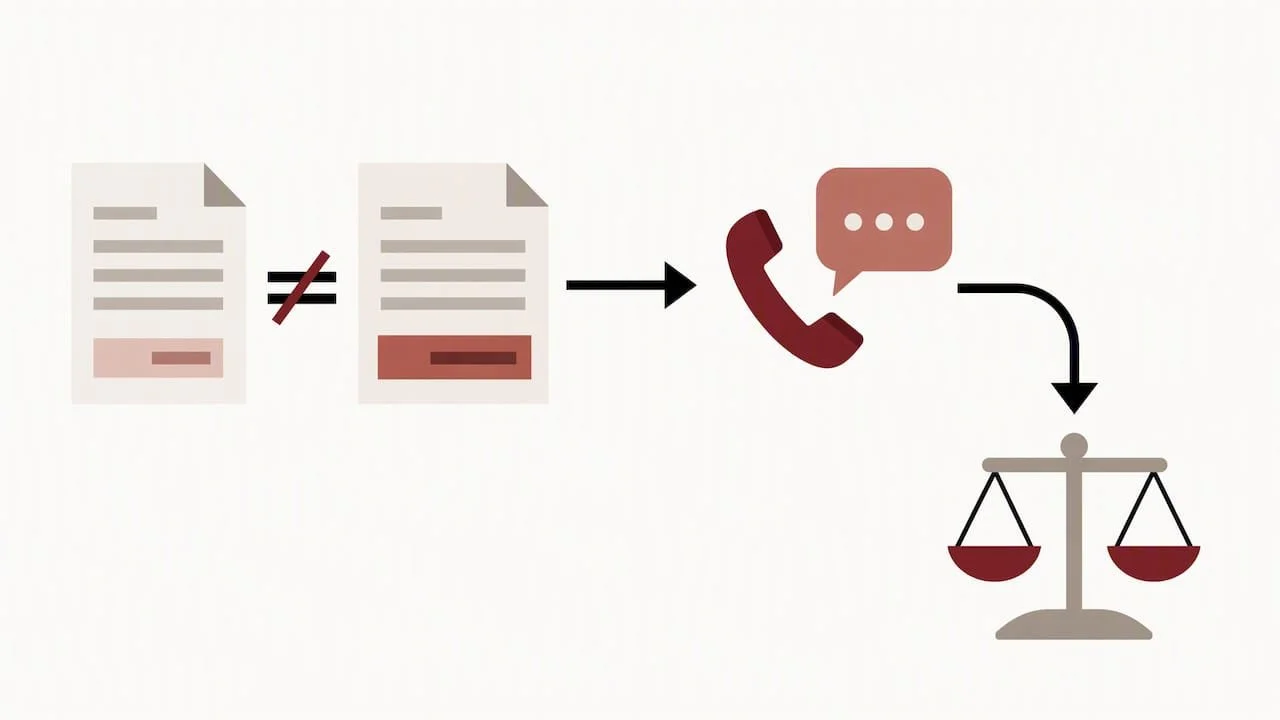
If you are eventually billed more than the estimate, contact the provider first. Many discrepancies are simple errors or missed assumptions that a billing office can correct directly. If the difference is $400 or more above the GFE for that provider, and it cannot be resolved informally, you may be eligible to initiate the federal Patient-Provider Dispute Resolution process, which exists specifically as a backstop for cases like this.
Building a compliance workflow therapists can actually follow
A GFE requirement only works if it is built into scheduling, not treated as a one-off paperwork task. A practical workflow looks like this:
At intake, flag self-pay or uninsured status with a simple checkbox or scripted question, so the system knows a GFE is required.
Document the date of the scheduling request, since that date determines the delivery deadline.
Draft an itemized estimate covering the expected service type, code, frequency, and per-session or per-package charge.
Deliver the GFE within the applicable deadline and retain proof of delivery, whether an email timestamp, portal log, or signed intake form.
Update the GFE whenever scope changes, such as adding sessions, switching to an intensive, or extending a 12-month estimate.
Archive every version of the GFE alongside appointment notes and billing records for as long as a dispute could reasonably arise.
This matters as much for EMDR intensives and immigration evaluations as it does for weekly therapy. Intensives are billed as flat project fees, so the GFE should break down the per-day or per-hour structure rather than a simple per-session rate. Immigration evaluations often involve multiple components, interviews, testing, and report drafting, so each should appear as its own line item with its own expected charge.
| Workflow step | What it requires | Why it matters |
|---|---|---|
| Identify self-pay status | Intake checkbox or scripted question | Triggers the GFE requirement automatically |
| Record scheduling date | Noted in scheduling system | Determines the delivery deadline |
| Draft itemized estimate | Service codes, charges, frequency | Meets CMS content requirements |
| Deliver and document proof | Email, portal log, or signed form | Protects against disputes later |
| Update on scope change | Revised GFE, 1 business day before new service | Keeps estimate accurate and compliant |
For recordkeeping specifically tied to potential disputes, CMS's PPDR decision tree recommends keeping the original GFE, any revised versions, the itemized final bill, appointment records, and all related correspondence, grouped by the provider or facility named on the estimate.
Pro Tip: Store GFE records by client and by provider, not just by date, since PPDR eligibility is assessed per provider or facility listed on the estimate.
Clinicians working across state lines should also confirm how licensure and telehealth rules intersect with estimate delivery, since telehealth psychiatric care for Arizona residents offers insights about navigating insurance acceptance and psychiatric evaluations (Reclaim Hope Psychiatry & Wellness) that can affect documentation practices. Practices serving victims of crime through state compensation programs may find it useful to model their GFE recordkeeping on the same discipline used for CalVCB documentation, where paperwork accuracy directly affects reimbursement.
Templates from professional associations are a practical starting point rather than a final answer. The CAMFT sample Good Faith Estimate form offers therapy-specific language that can be adapted to a practice's own services and fee structure.
What happens if the bill is higher than the estimate: the PPDR process
The Patient-Provider Dispute Resolution process exists for one specific scenario: a patient's final bill from a provider or facility comes in at $400 or more above the GFE issued for that same provider or facility. According to HHS PPDR guidance, eligibility and review happen on a per-provider basis, meaning a dispute looks only at the gap between the estimate and the bill for that specific provider or facility, not the patient's total spending across multiple providers.
Key rules of the process:
The patient must initiate the dispute within 120 calendar days of receiving the bill in question.
Documentation required includes the original GFE, the itemized final bill, and contact information for both patient and provider.
A selected dispute resolution (SDR) entity reviews the documentation and determines a payment amount, generally based on the GFE or the median payment for similar services in the area.
Initiating the process carries an administrative fee, currently $25, which may be refunded to the patient if the SDR entity rules in their favor.
This process is meant as a backstop after direct conversation with the provider has failed to resolve the discrepancy. For therapists, it underscores why documentation discipline matters: a well-kept GFE trail makes any dispute faster and clearer for everyone involved. The underlying regulatory authority for both the GFE and PPDR requirements comes from the interim final rule on surprise billing, published in the Federal Register in 2021.
Sample GFE structures for common therapy scenarios
Numbers help more than abstract rules. Here is how a few common therapy scenarios might be structured on a compliant GFE, with illustrative figures only:
| Scenario | Service structure | Example per-unit charge | Example total (illustrative) |
|---|---|---|---|
| Weekly individual therapy | 50-minute sessions, weekly, 12-month estimate | say $120 per session | roughly $6,240 for 52 sessions |
| 1-Day EMDR Intensive (4 hours) | Single-day intensive | flat project fee | stated as a single line item, not per hour |
| 3-Day EMDR Intensive | Multi-day intensive across three days | flat project fee | stated as one aggregated package charge |
| Immigration evaluation | Interview, testing, report writing | itemized by component | sum of each component's expected charge |
The weekly example above is illustrative math only: 52 sessions at a hypothetical $120 each totals $6,240, shown here purely to demonstrate how a 12-month recurring estimate should be presented, with frequency, per-session fee, and timeframe all stated clearly, as required for recurring-service GFEs.
A short annotated template a practice can adapt includes:
Provider name, NPI, and contact information at the top.
A table of services with code, description, frequency, and per-unit charge.
A stated assumption line (for example, "assumes no missed sessions; cancellation fees billed separately").
A note on the 12-month limit and when a new estimate will be issued.
The required dispute-rights notice and $400 threshold language.
Clinicians estimating frequency for recurring EMDR work may also want to reference evidence-based session benchmarks by trauma type when deciding how many sessions to project on a GFE.
Why transparent cost estimates matter in trauma-informed care
Clear billing is part of consent, not separate from it. When a client walks into trauma work without knowing what it costs, that uncertainty can sit alongside the vulnerability the work already asks of them, and the two compound each other in ways that have nothing to do with clinical skill.
We treat Good Faith Estimates as a basic extension of the same transparency we bring to treatment planning. For EMDR intensives, that means breaking down the flat project fee by day so clients know what each part of the process covers. For immigration psychological evaluations, it means itemizing the interview, testing, and report components separately, since those evaluations often carry weight far beyond the therapy room. For ongoing individual and couples work, it means stating our assumptions about frequency and duration plainly, and updating the estimate the moment that changes.
Bilingual, culturally responsive care only works if clients fully understand the terms they are agreeing to, in whichever language they are most comfortable in. A cost estimate that clients cannot parse, or trust, undermines the safety a trauma-informed practice is supposed to create before a single session begins.
— Juiced
Requesting a Good Faith Estimate from Alvarado Therapy
If you are considering trauma-focused care and want cost clarity before your first session, we provide itemized Good Faith Estimates for self-pay services we offer, including individual counseling, couples therapy, EMDR intensives, and immigration psychological evaluations. You do not need insurance to request one, and you do not need to commit to anything first.

Ask for a GFE when you schedule, or request one directly before booking if you want to compare options first.
For EMDR intensives, we break the flat project fee down by day so you know exactly what each session block includes.
For individual counseling and EMDR therapy, we outline per-session fees and anticipated frequency up front, with updates if your treatment plan changes.
For immigration evaluations, we itemize each component of the evaluation so the total cost is clear before the process starts.
Reach out through our intake process to request your estimate in writing, and keep a copy for your own records once it arrives. If a question comes up about what a line item covers, ask us directly before your first appointment, not after.
This article is general information, not a substitute for advice from a qualified doctor. Consult a qualified healthcare professional about your own circumstances before acting on anything here.
FAQ
What is a Good Faith Estimate in therapy?
A Good Faith Estimate is an itemized, written estimate of the services a therapy practice expects to provide and what each is likely to cost, given to uninsured or self-pay clients and to anyone who requests one. It is not a bill and does not guarantee a fixed number of sessions, since actual treatment can shift based on clinical need.
Who is entitled to receive a therapy Good Faith Estimate?
Uninsured and self-pay patients are entitled to a GFE automatically when they schedule care, and any patient, insured or not, can request one directly. Practices should treat a self-pay intake as an automatic trigger for issuing the estimate.
How soon must a therapist provide a Good Faith Estimate?
When care is scheduled 3 to 9 business days ahead, the GFE must be delivered within 1 business day of scheduling; when scheduled 10 or more business days ahead, it must arrive within 3 business days. A direct request, without scheduling, also must be answered within 3 business days.
What can I do if my therapy bill is higher than my estimate?
Contact your provider first, since many gaps come from simple billing errors or missed assumptions. If the final bill is $400 or more above the GFE for that same provider, you may be eligible to initiate the Patient-Provider Dispute Resolution process within 120 days of receiving the bill.
Can one Good Faith Estimate cover a full year of weekly therapy?
Yes, a single GFE can cover recurring therapy for up to 12 months if it clearly states the session frequency, the per-session fee, and the anticipated timeframe, according to CMS guidance on recurring services. If treatment is likely to continue past 12 months, the provider should issue a new estimate for the extended period.
